Friday, July 15, 2011
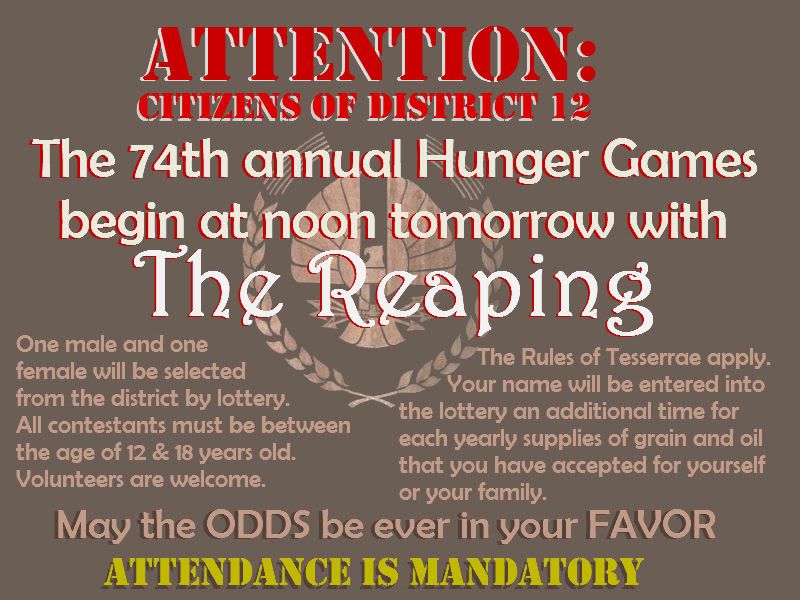
Multi-Genre Project: The Reaping Poster
In the story "The Hunger Games" Everything starts to really go down the tubes for the main character, Katniss, when her little sister is chosen in the Reaping. Katniss loves her little sister Prim with all of her heart and when Prim gets chosen to for the Hunger Games is breaks Katnisse's heart. She has two choices, she can either sit back and watch as her innocent little sister marches off towards certain death or she can take her sisters place and most likely end up dead herself. This causes a lot of emotional distress for Katniss and she reflects on her decision and her feelings often throughout the book. I created a fictitious poster that may have been displayed around District 12 by the Capital to inform the citizens about the upcoming event. I'm certain that if Katniss had seen this poster before the Reaping she would have been filled with rage and would have probably ripped it right off the wall.


Multi-Genre Project: The Hunger Games Quiz Gale vs. Peeta
There are two very strong male characters in the novel "The Hunger Games" and the main female character, Katniss, is caught is a love triangle with them. Katniss is constantly thinking about the two young men in her life and this creates a lot of confusing emotions for her. He doesn't know if she is feeling love, lust or hatred most of the time. This type of situation always causes readers to choose sides. I created a quiz to help people decide if they would rather be with Gale or Peeta. Which team are you on?
TAKE THE QUIZ!
TAKE THE QUIZ!
Multi-Genre Project: The Hunger Games Soundtrack
I have read the novel "The Hunger Games" By Suzanne Collins. As I read the gripping tale of Katniss I would find myself feeling the same ways that Katniss was feeling. If Katniss was depressed then so was I and if Katniss was feeling mushy and in love then so was I. One of the major ways that I express my emotions is through the kinds of music that I listen to. AS I read the book my emotional link to Katniss created a soundtrack. I decided to create a podcast that highlighted some of the songs that I was listening to as I read and connected emotionally with Katniss.
OR you can download the mp3 HERE.
Please comment and let me know what songs were playing in your head when you read the book.
OR you can download the mp3 HERE.
Please comment and let me know what songs were playing in your head when you read the book.
Wednesday, July 13, 2011
Online Learning
Online learning is the future. Or so I have been told. I fully agree that the world is changing, the way we access information is changing, and the things students need are changing. I see that education must change in order to serve the masses and online learning seems to be the answer to the question. The problem that I see is in the quality of the education that can be gained in an online environment. Online courses today don’t have the kind of robust depth or interaction that I would look for in an educational experience. That being said, I think they could. I think online learning could be extremely wonderful and fantastic but I feel it needs to grow out of its infancy.
While reading through the Michigan Merritt Guidelines on online learning I noticed right away that there was an emphasis on “substantive conversation”. The guidelines require that online learning have some from of interpersonal interaction happening so that students and teachers can learn from one another. As of right now, that usually means that students have to create post on blogs, forums, or discussion board. Then, other students need to reply to those posts. The problem is that most online students are not going to take the time to reply to something unless they absolutely have to. This causes instructors to require replies and then something terrible happens. People interact with one another because they have to. Its almost like virtual small talk. As an educator, I feel like this type of interaction is the worst type of interaction that can take place in a learning environment. I would almost prefer that students not interact at all if they are only doing it on a superficial level because they are being required to.
I would like to create a way to make substantive conversation an authentic experience like it is in a brick and mortar classroom. There are ways that we can get online students to interact in more authentic ways than post and replies to blogs. I think products like Voice Thread are creating a great way to interact. I would like to implement that kind of interaction in my classroom because I think it is much better than simple text on a screen. I would also bet that a product such as voice thread will intrigue most students enough that they would want to respond and interact.
While reading through the Michigan Merritt Guidelines on online learning I noticed right away that there was an emphasis on “substantive conversation”. The guidelines require that online learning have some from of interpersonal interaction happening so that students and teachers can learn from one another. As of right now, that usually means that students have to create post on blogs, forums, or discussion board. Then, other students need to reply to those posts. The problem is that most online students are not going to take the time to reply to something unless they absolutely have to. This causes instructors to require replies and then something terrible happens. People interact with one another because they have to. Its almost like virtual small talk. As an educator, I feel like this type of interaction is the worst type of interaction that can take place in a learning environment. I would almost prefer that students not interact at all if they are only doing it on a superficial level because they are being required to.
I would like to create a way to make substantive conversation an authentic experience like it is in a brick and mortar classroom. There are ways that we can get online students to interact in more authentic ways than post and replies to blogs. I think products like Voice Thread are creating a great way to interact. I would like to implement that kind of interaction in my classroom because I think it is much better than simple text on a screen. I would also bet that a product such as voice thread will intrigue most students enough that they would want to respond and interact.
Universal design for Learning
Recently I created a Geometry lesson plan that had a very heavy technology presence. I was pretty proud of the lesson because of its integration of technology and the benefits that would have. Today, I learned about a concept called "Universal Design for Learning" and it pointed out some other great features of my lesson plan.
Universal design for learning (UDL) is a technique or framework for designing lessons that will work universally for all students that enter your classroom. Its a really interesting concept that can have a very broad scope. The concept of a school and of a student are changing and diversifying so that means that teachers need to be more dynamic in their teaching techniques. A simple "One size fits all" approach to lesson planning is not an effective way to pass on knowledge so teachers need to try and reach all of the different kinds of learners that enter their environment. To put it simply and bluntly, teachers need to do their best to reach those students that are on the fringe of "normal".
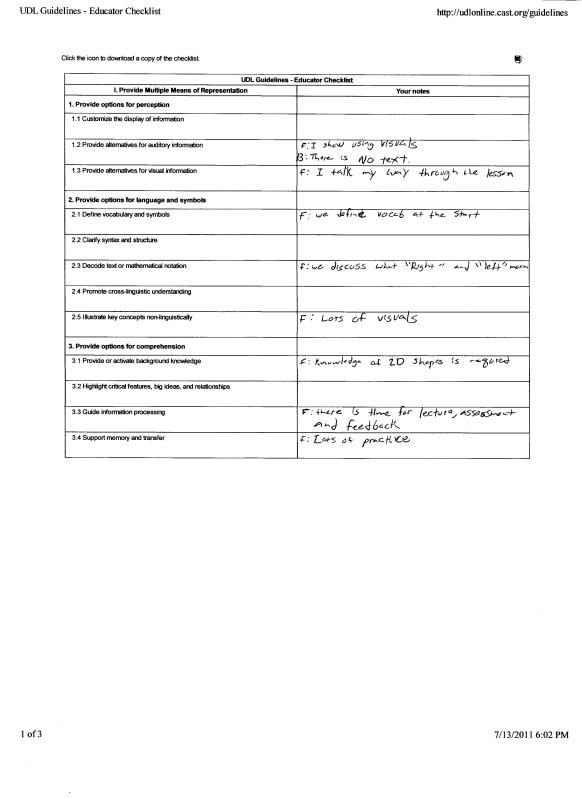
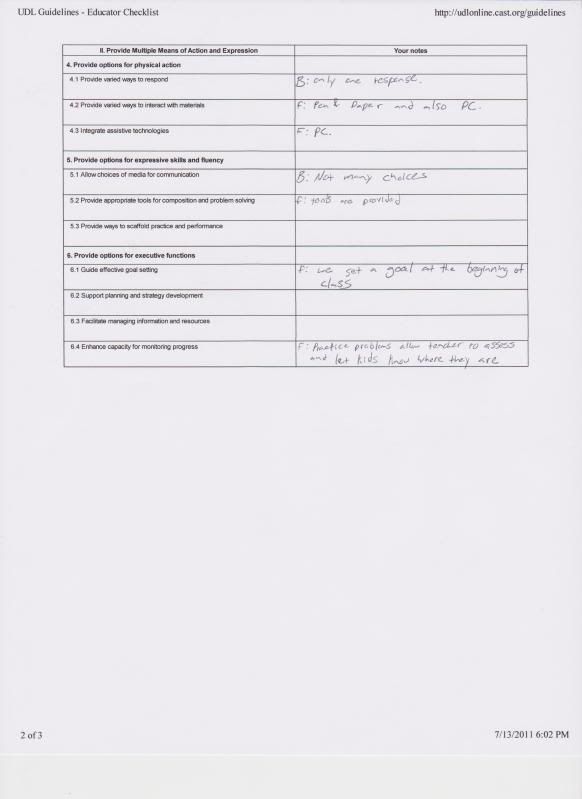
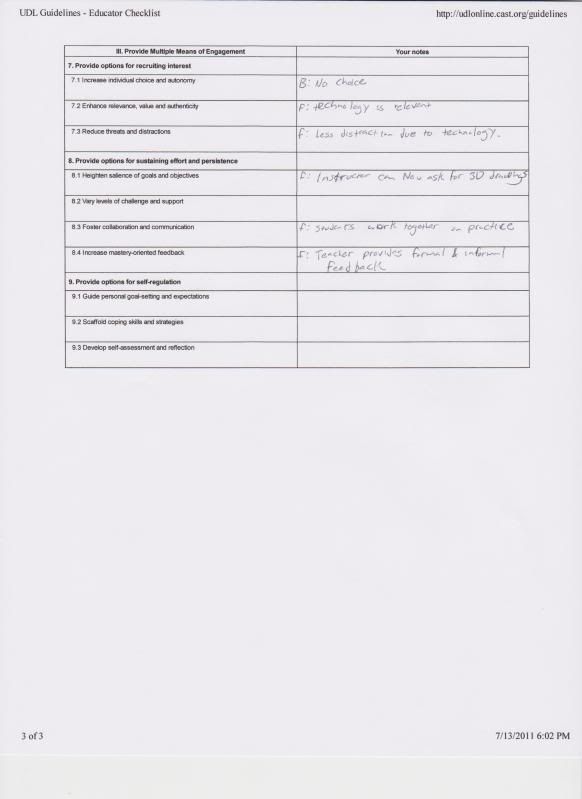
CAST has created a UDL checklist to help educators implement the design in their own classes. I recently printed off this checklist and found all of the ways that my recent Geometry lesson aligned with the UDL checklist. I found that I did a really great job on some of the points, others I did a really bad job on, and others I didn't even touch. All of my comments start with an "F:" of a "B:". F stands for a "feature" of my lesson while B stands for a "Barrier" that students will have to overcome.
Here is my filled out checklist.


Universal design for learning (UDL) is a technique or framework for designing lessons that will work universally for all students that enter your classroom. Its a really interesting concept that can have a very broad scope. The concept of a school and of a student are changing and diversifying so that means that teachers need to be more dynamic in their teaching techniques. A simple "One size fits all" approach to lesson planning is not an effective way to pass on knowledge so teachers need to try and reach all of the different kinds of learners that enter their environment. To put it simply and bluntly, teachers need to do their best to reach those students that are on the fringe of "normal".
CAST has created a UDL checklist to help educators implement the design in their own classes. I recently printed off this checklist and found all of the ways that my recent Geometry lesson aligned with the UDL checklist. I found that I did a really great job on some of the points, others I did a really bad job on, and others I didn't even touch. All of my comments start with an "F:" of a "B:". F stands for a "feature" of my lesson while B stands for a "Barrier" that students will have to overcome.
Here is my filled out checklist.
Wednesday, July 6, 2011
Teaching as a Scholarly Pursuit
I have viewed teaching through a number of different frameworks during my short time on this planet. People have told me that teaching is not a profession but rather a trade. Others have insisted that teaching is the passing on of nuggets of knowledge from one generation to the next. Now, many people exclaim that teaching is a guiding process that assists student on their path to knowledge. So many different ideas and so many different teaching styles. In the end, teaching is a progressive and evolving task that will always be everything and nothing all at the same time. The concept of evolution can take educators in a lot of different directions if they are left to their own devices but there is a way to come together and help one another change and grow in only positive ways.
Teaching will change. That is a certainty but if we want to make sure it changes for the better then is it important to view teaching as a scholarly pursuit. When I say scholarly I mean research, meta cognition, collaboration, and feedback. Many times, teachers close their doors and teach on their own little island that is free of outside influences. This isn't necessarily a good thing. Like the old say says "Two heads are better than one." Teachers need to work together to move forward. If you are a fantastic teacher then you should share your great techniques and if you are anything less then fantastic then a little collaboration could help bring you closer to your wonderful potential. Also, Teachers need to look outside of their own school walls to continue their development. Collaborating can mean reading and writing scholarly articles about teaching and learning strategies. Teachers can even attend conferences and seminars. The most important thing is that teacher continue to seek out answers to questions. We must all continue to strive if we want our students to do the same.
I myself have implemented a number of scholarly concepts into my own teaching practice. Many of the things I have done I did not readily identify as scholarly pursuits but was happy to do anyway. Firstly, I became a member of the National Council of Teachers of Mathematics when I was finishing up my undergraduate degree and have read about numerous studies and concepts in their journals that have directly effected my classroom strategies. Also, I have always maintained an open door policy in my classroom. My classroom is always open to visitors weather they be administrators, parents, or other teachers. I don't know that I can revolutionize the way someone feels about teaching but I bet I could help them uncover some interesting ideas. Also, there is a good chance that other might be able to help me uncover my own ideas. I love to hear about ways I could make my classroom better. Finally, I take part in a lot of professional development that I hope will improve my teaching though my learning. Masters courses, district offerings, symposiums, and regional conferences have all had a great effect on me and helped me see exactly how I compare to those around me.
The most interesting thing about the scholarship of teaching is that it isn't exactly a new idea. Most teachers are already scholarly in some way or another but now is the time to refocus and view our own techniques in a new way to help further the entire profession.
Teaching will change. That is a certainty but if we want to make sure it changes for the better then is it important to view teaching as a scholarly pursuit. When I say scholarly I mean research, meta cognition, collaboration, and feedback. Many times, teachers close their doors and teach on their own little island that is free of outside influences. This isn't necessarily a good thing. Like the old say says "Two heads are better than one." Teachers need to work together to move forward. If you are a fantastic teacher then you should share your great techniques and if you are anything less then fantastic then a little collaboration could help bring you closer to your wonderful potential. Also, Teachers need to look outside of their own school walls to continue their development. Collaborating can mean reading and writing scholarly articles about teaching and learning strategies. Teachers can even attend conferences and seminars. The most important thing is that teacher continue to seek out answers to questions. We must all continue to strive if we want our students to do the same.
I myself have implemented a number of scholarly concepts into my own teaching practice. Many of the things I have done I did not readily identify as scholarly pursuits but was happy to do anyway. Firstly, I became a member of the National Council of Teachers of Mathematics when I was finishing up my undergraduate degree and have read about numerous studies and concepts in their journals that have directly effected my classroom strategies. Also, I have always maintained an open door policy in my classroom. My classroom is always open to visitors weather they be administrators, parents, or other teachers. I don't know that I can revolutionize the way someone feels about teaching but I bet I could help them uncover some interesting ideas. Also, there is a good chance that other might be able to help me uncover my own ideas. I love to hear about ways I could make my classroom better. Finally, I take part in a lot of professional development that I hope will improve my teaching though my learning. Masters courses, district offerings, symposiums, and regional conferences have all had a great effect on me and helped me see exactly how I compare to those around me.
The most interesting thing about the scholarship of teaching is that it isn't exactly a new idea. Most teachers are already scholarly in some way or another but now is the time to refocus and view our own techniques in a new way to help further the entire profession.
Friday, July 1, 2011
My PLC is Enhanced
My personal learning network has grown a lot in the past few days. It has definitely gotten much bigger in size and I think that is wonderful. I have met and leanred from a lot of great new colleges that have a diverse and powerful wealth of knowledge and I’ve also connected to some great groups such as MACUL. I think of those things are really great BUT I don’t think it’s the biggest change that my personal learning community has experienced.. The biggest change is that my learning community is more interconnected. I feel like my PLC is constantly swarming around me offering up suggestions and information. It has seeped into my social networks merging fun and professionalism. I feel like I get more bang for my buck because there is a much higher concentration of quality information at my fingertips.


Subscribe to:
Posts (Atom)